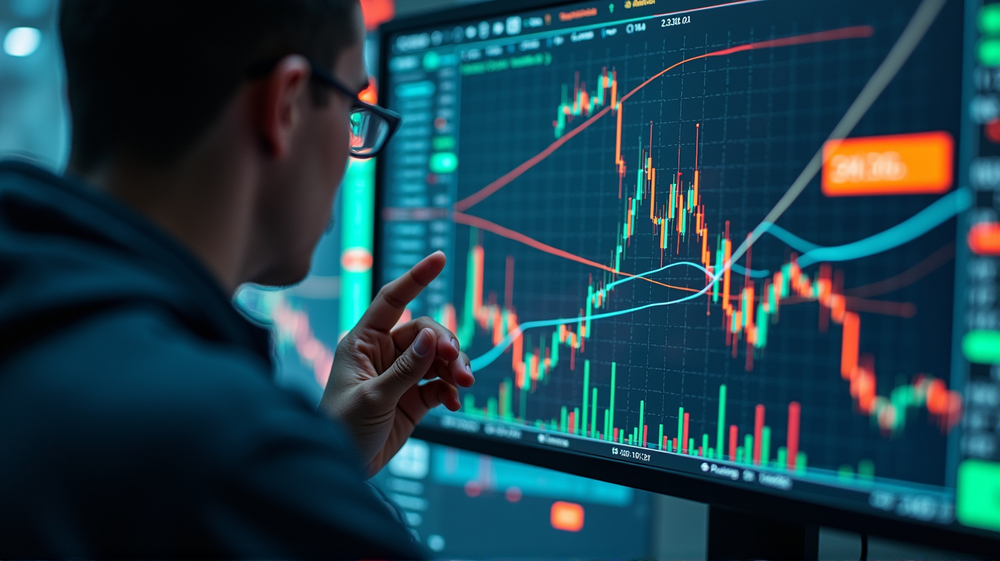
Backtesting Definition: What It Means in Trading and Investing
Backtesting is the process of applying a trading or investing rule to historical market data to estimate how that rule would have performed in the past. In plain language, it is a “history-based strategy check” that helps you assess whether an idea has any evidence behind it before you risk real capital. When I teach passive income principles in Singapore, I position this kind of historical performance testing as a stability tool: it can improve decision discipline, but it cannot remove uncertainty.
In practice, Backtesting is used across major markets—stocks, forex, and crypto—as well as indices and ETFs. Traders may run strategy simulation on short timeframes (intraday to weekly), while long-term investors often test monthly or quarterly rules. Importantly, a strong past result does not guarantee future profits; market regimes change, costs shift, and liquidity can disappear when you need it most.
Disclaimer: This content is for educational purposes only.
Key Takeaways
- Definition: Backtesting checks a rule against historical prices to see how it would have behaved, including wins, losses, and drawdowns.
- Usage: It supports planning in stocks, forex, crypto, indices, and portfolios through rule testing before trading live.
- Implication: It highlights whether returns may be linked to a repeatable edge or simply to a favourable market period.
- Caution: Poor assumptions (fees, slippage, data quality) can make results misleading, so treat findings as evidence—not certainty.
What Does Backtesting Mean in Trading?
In trading, Backtesting means taking a clearly defined strategy—entry rules, exit rules, position sizing, and risk limits—and evaluating it using past market data. It is not a “market sentiment” indicator and not a chart pattern by itself. Instead, it is a method: a structured way to validate whether a set of rules had any statistical merit under prior conditions.
Traders often describe it as historical strategy validation or past-data testing. The goal is to answer practical questions: What was the worst peak-to-trough drawdown? How long were losing streaks? Did performance depend on one exceptional year? For capital preservation, these risk-focused outputs are often more valuable than the headline return.
A robust review also separates “paper results” from “tradeable results.” That means accounting for transaction costs, spreads, commissions, borrow fees (if short selling), and slippage. It also requires defining the test period (e.g., 10 years), the instrument universe (e.g., a basket of liquid stocks), and execution rules (e.g., next-day open). Without these details, what looks like Backtesting may be closer to storytelling.
How Is Backtesting Used in Financial Markets?
Backtesting is used differently depending on the market structure, costs, and trading horizon. In stocks, investors often run portfolio backtest studies to compare rules such as dividend reinvestment, value screens, or trend-following overlays. Because equities have corporate actions (splits, dividends, delistings), quality data and survivorship-bias controls matter.
In forex, spreads and rollover (swap) can dominate outcomes for short-term systems. A realistic strategy simulation will include typical spreads by session, slippage around news, and position limits. Time horizon is crucial: a rule that looks attractive on 5-minute charts can degrade once you include execution friction.
For crypto, regime shifts are common: volatility, correlations, and liquidity can change rapidly. Here, historical performance testing is useful for stress-testing drawdowns and ensuring the strategy does not rely on one extraordinary bull run. It also helps evaluate risk controls such as maximum exposure, volatility targeting, or holding stable cash equivalents during high-risk periods.
Across indices and ETFs, Backtesting supports risk management: setting stop-loss logic, defining rebalance frequency, and evaluating whether diversification actually reduced drawdowns. Used well, it turns vague “ideas” into measurable rules that can be monitored and adjusted over time.
How to Recognize Situations Where Backtesting Applies
Market Conditions and Price Behavior
Backtesting is most relevant when you can define a repeatable market behaviour in objective terms. For example, markets often rotate between trending phases and range-bound phases. A past-data test can show whether a trend strategy performs only in strong bull markets, or whether it survives choppy conditions with acceptable drawdowns. For stability-focused investors, I look closely at the “pain points”: maximum drawdown, time to recover, and the distribution of monthly returns.
It also applies when volatility changes. Strategies that appear resilient in calm periods may struggle when volatility spikes. Running Backtesting across multiple volatility regimes helps you understand whether risk controls (like reduced sizing) are necessary.
Technical and Analytical Signals
When a strategy is based on technical signals—moving-average crossovers, breakout rules, mean reversion bands, or volume filters—Backtesting (also known as historical strategy validation) is almost mandatory. The reason is simple: technical rules can be easily overfitted. A credible test uses consistent signal definitions, avoids peeking into the future, and applies realistic execution timing (e.g., signal on close, entry at next open).
It is also useful for parameter decisions. If a rule “only works” with one exact setting (for example, one precise lookback length), that fragility is a warning sign. A robust approach looks for performance that remains acceptable across a reasonable range of settings.
Fundamental and Sentiment Factors
Backtesting is equally applicable to fundamental and sentiment-driven rules, but the data must be handled carefully. Examples include valuation screens, earnings quality metrics, macro filters, or risk-on/risk-off indicators. A proper rule testing framework aligns release dates correctly (so you do not use information before it was public) and considers practical constraints such as rebalancing frequency and turnover.
Finally, consider the “why.” If there is no plausible economic rationale—only a nice-looking equity curve—treat the result as a hypothesis, not a conclusion. In capital-preservation terms, the purpose is to reduce preventable mistakes, not to chase the highest backtested return.
Examples of Backtesting in Stocks, Forex, and Crypto
- Stocks: You define a conservative dividend strategy: buy a diversified set of liquid, dividend-paying companies, rebalance quarterly, and cap exposure per sector. You run Backtesting with dividends reinvested and include realistic commissions. The portfolio backtest may reveal that returns are steady but drawdowns still occur during recessions, prompting you to add a simple risk filter (for example, reducing equity exposure when the broad market trend turns negative).
- Forex: You test a rules-based breakout system that trades only during high-liquidity sessions and uses fixed risk per trade. A strategy simulation that includes spreads and slippage shows the system performs well in trending periods but gives back gains during sideways markets. You then refine the plan by adding a volatility condition and by tightening maximum daily loss limits.
- Crypto: You test a long-only trend-following rule that holds major, liquid coins and shifts partially to cash equivalents when trend signals weaken. Backtesting with realistic fees shows that performance is highly regime-dependent: strong in bull runs, challenged in sharp mean-reverting markets. The historical performance testing output highlights whether position sizing and drawdown controls are adequate for your risk tolerance.
Risks, Misunderstandings, and Limitations of Backtesting
Backtesting is useful, but it is easy to misuse—especially if you treat a backtested equity curve as a promise. The biggest practical limitation is that markets evolve: liquidity, participant behaviour, regulation, and correlations change. A result that looks stable in one decade can fail in the next. In my experience, capital preservation depends on assuming that the future will be “different enough” to hurt the strategy.
Another risk is unrealistic inputs. A clean past-data test that ignores fees, spreads, borrow costs, or slippage can materially overstate performance. Data issues also matter: survivorship bias (only testing today’s winners), look-ahead bias (using future information), and curve-fitting (tuning parameters until you “find” returns) can all create false confidence.
- Overconfidence: Strong backtested returns can encourage oversized positions and weak risk controls.
- Misinterpretation: A strategy may be capturing a one-off regime rather than a repeatable edge, so diversify across assets and approaches.
How Traders and Investors Use Backtesting in Practice
Professionals typically treat Backtesting as one layer in a research pipeline. They start with a hypothesis, build rules, run a historical strategy validation over long datasets, and then test robustness with out-of-sample periods and stress scenarios. Position sizing is often based on volatility or risk budgets, not on conviction. Stop-losses and risk limits are defined upfront, and results are evaluated with drawdown, hit rate, payoff ratio, and exposure.
Retail traders can follow the same discipline at a smaller scale. Begin with one simple, testable idea and document it like a checklist: entry trigger, exit trigger, timeframe, and maximum risk per trade. Then run a rule testing process that includes realistic costs and conservative assumptions. For passive-income minded investors, the most practical outcome is not “the best strategy,” but a clear understanding of worst-case behaviour and whether you can hold through it without abandoning the plan.
Finally, treat the process as iterative. A strategy that passes Backtesting can still fail in live markets, so consider paper trading, small sizing, and periodic review. If you want a structured next step, read an internal Risk Management Guide and build your rules around capital protection first.
Summary: Key Points About Backtesting
- Backtesting (i.e., historical performance testing) applies a rule to past data to estimate returns, drawdowns, and consistency.
- It is widely used across stocks, forex, crypto, indices, and portfolios to convert ideas into measurable, risk-aware plans.
- Results can mislead when costs, biases, and regime changes are ignored; diversification and risk limits remain essential.
- Use the output to improve discipline—especially position sizing and stop-loss logic—not to assume certainty.
To deepen your foundation, focus next on basics like portfolio construction, risk budgeting, and a practical Risk Management Guide that prioritises capital preservation.
Frequently Asked Questions About Backtesting
Is Backtesting Good or Bad for Traders?
Good when used correctly, because it quantifies risk and sets realistic expectations. Bad when treated as a guarantee or when a strategy simulation ignores costs and market changes.
What Does Backtesting Mean in Simple Terms?
It means testing your trading rules on old price data to see how they would have performed, like a “trial run” using history.
How Do Beginners Use Backtesting?
Start with one simple rule set, include fees and spreads, and track drawdowns and losing streaks. Keep the past-data testing period long enough to cover different market conditions.
Can Backtesting Be Wrong or Misleading?
Yes, it can be misleading due to overfitting, biased datasets, or unrealistic assumptions. A clean-looking historical strategy validation can fail when volatility and liquidity shift.
Do I Need to Understand Backtesting Before I Start Trading?
Yes, at a basic level, because it helps you understand risk, set position sizes, and avoid relying on hope. You can trade without it, but you are more likely to make avoidable mistakes.
Disclaimer: This article is for informational purposes only and does not constitute financial advice. Always do your own research or consult a professional.