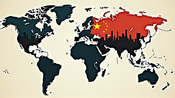
The passage of UN Security Council Resolution 2803 marks a pivotal moment in international diplomacy as the United States garners widespread global support for its comprehensive strategy to stabilize and secure Gaza. This resolution is seen as a victory for America’s foreign policy under the leadership of President Trump, aiming to not only cease hostilities but also integrate a broader peace plan for the region with substantial international involvement.
Securing International Consensus
On November 17, 2025, UN Resolution 2803 was adopted with an overwhelming majority, paving the way for the implementation of a US-led peace initiative in Gaza. The resolution garnered support from key international players including Egypt, Jordan, and Turkey, alongside other Arab states. These nations collectively backed the American draft to bring about a sustainable ceasefire, disarm militant groups, and ensure a strategic withdrawal of Israeli forces. According to Middle East Monitor, the consensus represents a unified front that resists divergent views from powerhouses like Russia and China, who abstained from the vote.
Framework for Peace and Stability
The resolution outlines a robust framework, envisioning the deployment of an International Stabilisation Force (ISF) under a unified command, chaired by President Trump. This force, distinct from traditional peacekeeping efforts, is tasked with enforcing peace through direct intervention if necessary. As part of the plan, the Israeli retreat is closely linked to achieving the disarmament of Hamas and de-escalation in the region.
Role of the Peace Council
Central to the resolution is the establishment of a Peace Council, to be chaired by Trump, tasked with governance oversight and reconstruction initiatives within Gaza. This body is empowered to prioritize funding and facilitate reconstruction efforts once significant reform milestones are met by the Palestinian Authority. Despite its extensive remit, the resolution does not assign a direct role to the Palestinian Authority within the Peace Council, highlighting the complexity of regional politics.
Diplomatic Chess: Russia and China’s Position
In opposition, Russia introduced a rival draft that emphasized traditional peacekeeping mechanisms and underscored the two-state solution. This draft was largely sidelined in favor of the American resolution. While the Russian position called for a more balanced approach to Gaza, focusing on linking governance with the West Bank, the resolution’s passage underscores a shift in diplomatic priorities and the US’s persuasive reach in global policymaking.
Controversy Over Palestinian Self-Determination
Despite its adoption, the resolution’s language around Palestinian self-determination remains cautious and non-committal, a point of contention for Hamas and many observers. The promise of Palestinian self-rule is deemed conditional, awaiting substantial reforms within the Palestinian Authority and broader security assurances. The reluctance to clearly outline a path to statehood reveals underlying geopolitical tensions and the challenges that remain.
Moving Forward: Reconstruction and Accountability
As the international community braces for the resolution’s implementation, questions linger about its long-term efficacy and the future political landscape in Gaza. With financial backing expected from Arab states and major international donors, the reconstruction phase will be closely monitored. Yet, the absence of explicit accountability and oversight mechanisms suggest that the road to peace will be fraught with challenges.
UN Resolution 2803 thus stands as a testament to the intricate dance of diplomacy on the world stage — a blend of strategy, power dynamics, and the enduring quest for peace in a troubled region. As stated in Middle East Monitor, the path forward requires not just international mandates but concerted efforts from all parties involved.