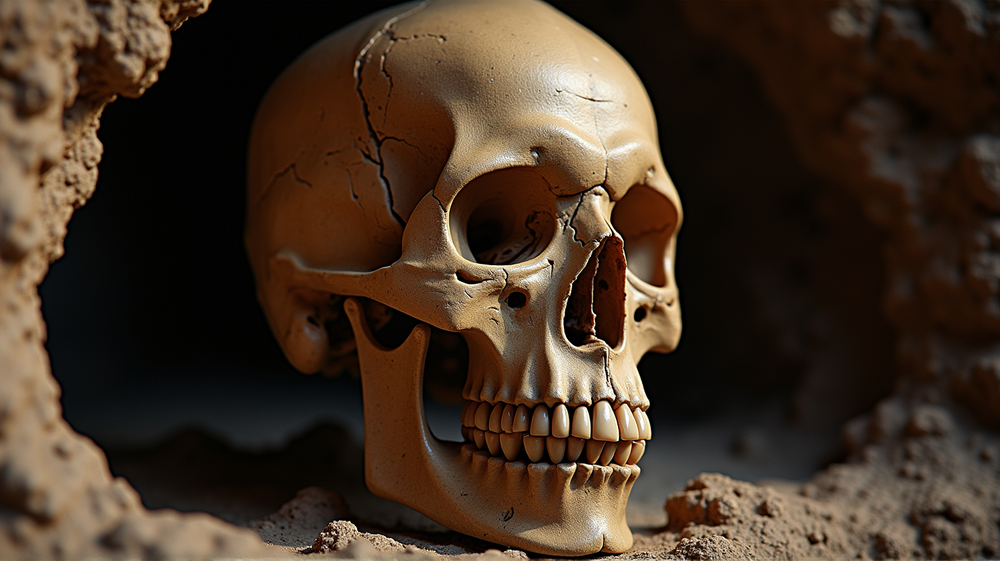
In a groundbreaking study, researchers have revealed that the long-standing theory suggesting Neandertals evolved large noses for cold climate adaptation might be entirely unfounded. According to the video footage obtained from the exceptionally preserved Altamura Man skull, these hominids had nasal passages strikingly similar to humans. This revolutionary insight reshapes our understanding of Neandertal adaptations and opens a fresh dialog in the world of paleoanthropology.
Altamura Man’s Legacy
The remains, discovered in an Italian cave, have been shielded by calcite, preserving the delicate nasal bones typically lost over time. The meticulous analysis using endoscopic technology has allowed scientists to create the first 3-D digital reconstructions of these internal structures. This method provided definitive evidence that Neandertal nasal cavities were not distinctively suited for breathing cold air. This refutes the early 20th-century proposition that attributed their prominent noses to climate adaptation.
A Shared Anatomy
Paleoanthropologist Constantino Buzi, involved with the study, emphasized that while the Neandertals did possess larger noses, the structural similarities with our own kind underscore the inefficacy of their noses as a cold-weather tool. This revelation is contrasted with adaptations seen in modern groups like the Arctic Inuit, whose narrower nasal passages are an evolutionary response to frigid environments.
Bridging Historical Gaps
Support for Buzi’s findings comes from independent academics, aiming to quell the lengthy debates within the anthropological community. Bruce Hardy notes that this observable evidence of internal nasal structures could finally disband speculative theories about Neandertal physiological evolution.
A New Perspective in Evolutionary Anthropology
This study not only illuminates the physiological parallels between Neandertals and modern humans but propels a vital conversation around the shared paths and unique variations of evolutionary traits. As stated in Science News, such advancements represent a step forward in understanding our ancestral connections.
The ongoing inquiry into Neandertal anatomy serves as a testament to scientists’ dedication towards decoding our complex past and dispelling historical inaccuracies through precise modern methodologies.