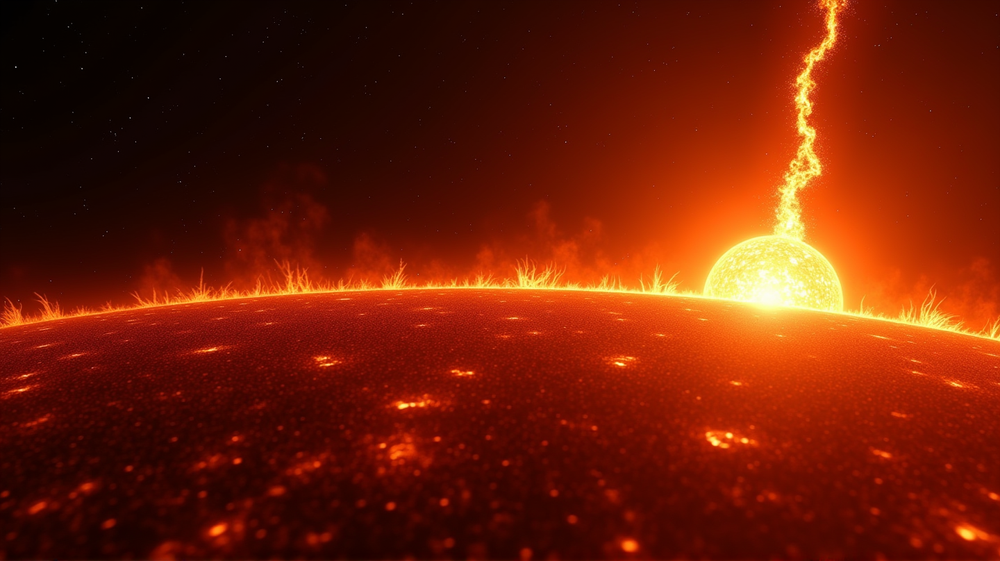
Imagine touching the Sun! While we can’t physically do so, NASA’s Parker Solar Probe has brought us closer than ever before to understanding the fiery giant by mapping the elusive boundary known as the Alfvén surface. This boundary represents the point where the Sun’s atmosphere ends and the solar wind begins, a mesmerizing transition that’s both frothy and spiky.
The Pathway to New Discoveries
The Parker Solar Probe, alongside other observatories like Solar Orbiter and Wind, was able to map this boundary in unprecedented detail. By daringly flying through the Alfvén surface, the Parker Solar Probe provided continuous, two-dimensional maps—an achievement that has reshaped our understanding of the Sun’s influence on our solar system.
A Dynamic and Changing Boundary
The revelations were published in the Astrophysical Journal Letters. They unveil how this boundary becomes more turbulent as the Sun enters a more active phase in its 11-year cycle. The data obtained using the SWEAP instrument suggests that the surface grows larger and more intricate, resembling a celestial dance of solar material that escapes at a million miles per hour.
Unveiling the Solar Cycle
This dynamic boundary’s fluctuation is key to understanding solar activity. As the Sun goes through its cycles, changes in the Alfvén surface could have profound implications for how we comprehend space weather, which influences not only our planet but also other celestial bodies across the universe.
Why This Matters
By pinpointing the precise location and nature of this solar boundary, scientists are on the path to answer profound questions about the Sun’s corona and the broader implications for life on Earth. These solar winds, which can affect our technology and even our climate, are now better understood thanks to this pioneering mission.
The Road Ahead
NASA’s continuous exploration and mapping of the Sun’s surface aim to unravel more mysteries surrounding the vast solar corona. With the Parker Solar Probe leading the frontier, our comprehension of the solar system is bound to accelerate in leaps and bounds. According to NASA Science (.gov), these findings are just a start in the odyssey to decode the universe’s radiant powerhouse.
Embark on this cosmic venture, as the Sun’s hidden layers unfold its majestic wonders right before our very eyes!